
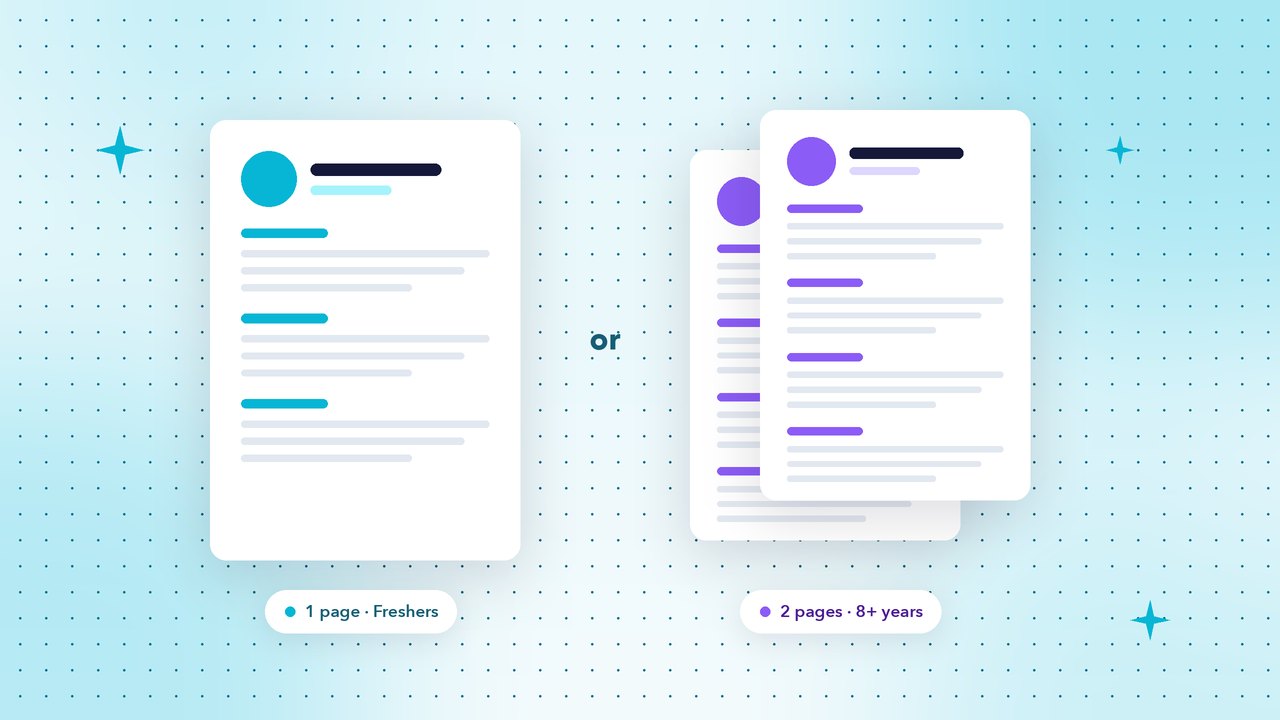
“Keep it to one page” is the most repeated resume advice — but it isn’t right for everyone. The ideal resume length depends on your experience, industry and the country you’re applying in. Here’s a simple way to decide.
Quick answer
| Experience level | Recommended length |
|---|---|
| Students and freshers | 1 page |
| 1–7 years of experience | 1 page (2 if every line is relevant) |
| 8+ years or managerial roles | 2 pages |
| Senior executives | 2 pages, occasionally 3 |
| Academic, research or medical roles | A longer CV with publications — see CV vs resume |
When a one-page resume is best
- You’re a student, fresher or have fewer than 5–7 years of experience.
- You’re changing careers and most of your past work isn’t relevant.
- You’re applying to a large company that receives thousands of applications.
- You’re handing out printed copies at a job fair.
When a two-page resume is fine
- You have 8+ years of relevant experience with measurable results.
- The role is technical and needs detailed skills, tools or certifications.
- You’re applying for leadership positions where scope and scale matter.
Rule of thumb: If page two is less than half full, cut it back to one page. If you need a second page, fill at least half of it and put your most important information on page one.
What recruiters actually care about
Length matters less than relevance. A recruiter would rather read two pages of strong, targeted achievements than one crowded page of tiny text. Your goal is to make the first half of page one so compelling that they keep reading.
9 ways to shorten your resume
- Cut older roles. Jobs from 10–15+ years ago can shrink to one line each: title, company, years.
- Limit bullets. 3–5 bullets for recent roles, 1–2 for older ones.
- Remove weak bullets. Delete duties anyone in the role would do; keep achievements.
- Tighten wording. Replace “was responsible for managing” with “managed”. Our action verbs list helps.
- Drop the objective and “references available on request”.
- Combine small sections such as certifications, languages and tools.
- Remove personal details like date of birth, full address and marital status.
- Adjust margins and spacing slightly — but keep the font at 10–12 pt.
- Tailor for each job and remove anything that doesn’t support the role.
Signs your resume is too short
- Large blank spaces at the bottom of the page.
- Bullets that describe duties without results.
- Missing sections such as skills, projects or certifications.
If that’s you, add project details, measurable achievements and relevant coursework. Our guide to writing a resume with no experience has ideas.
Our resume templates show a live preview so you can see exactly how your content fits on the page before you download your resume as a PDF.