
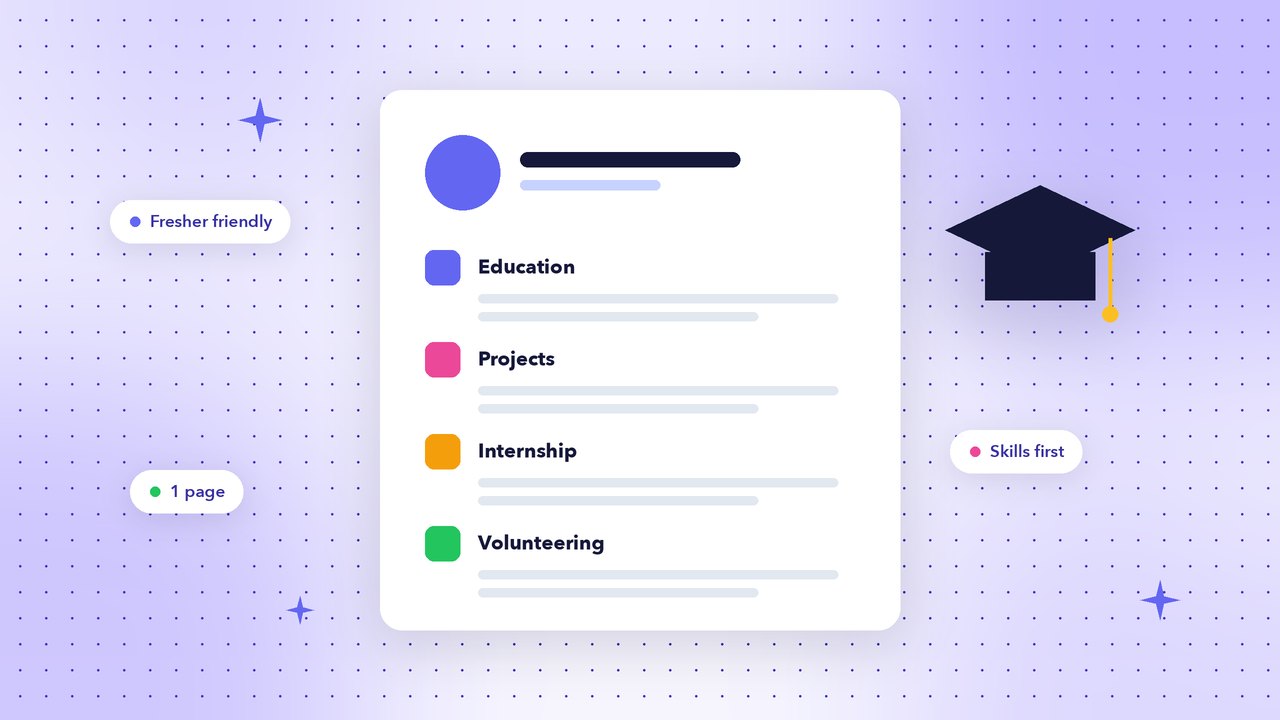
Writing your first resume can feel impossible when the “Experience” section is empty. The good news: employers hiring freshers don’t expect years of work history. They want proof that you can learn quickly, work with others and get things done. Here’s how to show it.
What to include on a resume with no experience
- Contact details: name, phone, professional email, city, and LinkedIn or portfolio link.
- Resume summary or objective: 2–3 lines on your degree, key skills and the role you want.
- Education: degree, college, graduation year, and your grade if it’s strong (e.g. 8.0+ CGPA or 70%+).
- Projects: academic, personal or freelance projects — the best substitute for work experience.
- Internships and training: even short or unpaid ones count.
- Skills: technical tools and soft skills relevant to the job.
- Certifications: online courses from Coursera, Google, NPTEL, HubSpot, etc.
- Activities and achievements: clubs, volunteering, competitions, sports, leadership roles.
Step 1: Choose the right format
Put your strongest sections first. For most freshers that means Education and Projects above Experience. Keep it to one page and use a clean, simple template so ATS software can read it. Learn more in resume formats explained.
Step 2: Write a short summary
Example: “Recent BBA graduate with strong Excel and communication skills. Completed a 2-month marketing internship and led a college fest team of 15 volunteers. Looking to start my career as a marketing executive.”
See more in our guide on how to write a resume summary.
Step 3: Turn projects into experience
Describe each project like a job: title, tools used, what you did, and the result.
- E-commerce website (college project): Built a shopping site with HTML, CSS, JavaScript and PHP; implemented cart and payment gateway; demoed to 50+ students and faculty.
- Market research study: Surveyed 200 customers on UPI usage, analysed results in Excel, and presented findings to the department.
Step 4: Highlight transferable skills
Part-time jobs, family businesses, tutoring and volunteering all build skills employers value:
| Activity | Skill it shows |
|---|---|
| Tutoring younger students | Communication, patience, explaining complex ideas |
| Organising a college event | Planning, teamwork, budgeting, leadership |
| Helping in a family shop | Customer service, cash handling, inventory |
| Running a social media page | Content creation, analytics, consistency |
| Hackathons and competitions | Problem-solving, working under deadlines |
Step 5: Add certifications
Free and low-cost certificates show initiative. Popular options include Google Digital Marketing, Google Data Analytics, Microsoft Excel, HubSpot Content Marketing, AWS Cloud Practitioner and NPTEL courses. List the name, platform and year.
Fresher resume mistakes to avoid
- Adding a photo, date of birth, religion or marital status unless the employer asks for it.
- Listing school marks from Class 5 onwards — Class 10 and 12 are enough, and only if you’re a recent graduate.
- Writing a long “objective” about your dreams instead of what you offer.
- Using a fancy two-column design that ATS software can’t read.
- Sending the same resume to every job — tailor your skills and summary each time.
For a deeper walkthrough, read our resume guide for freshers. When you’re ready, use the free resume builder to create your first resume and download it as a PDF.