
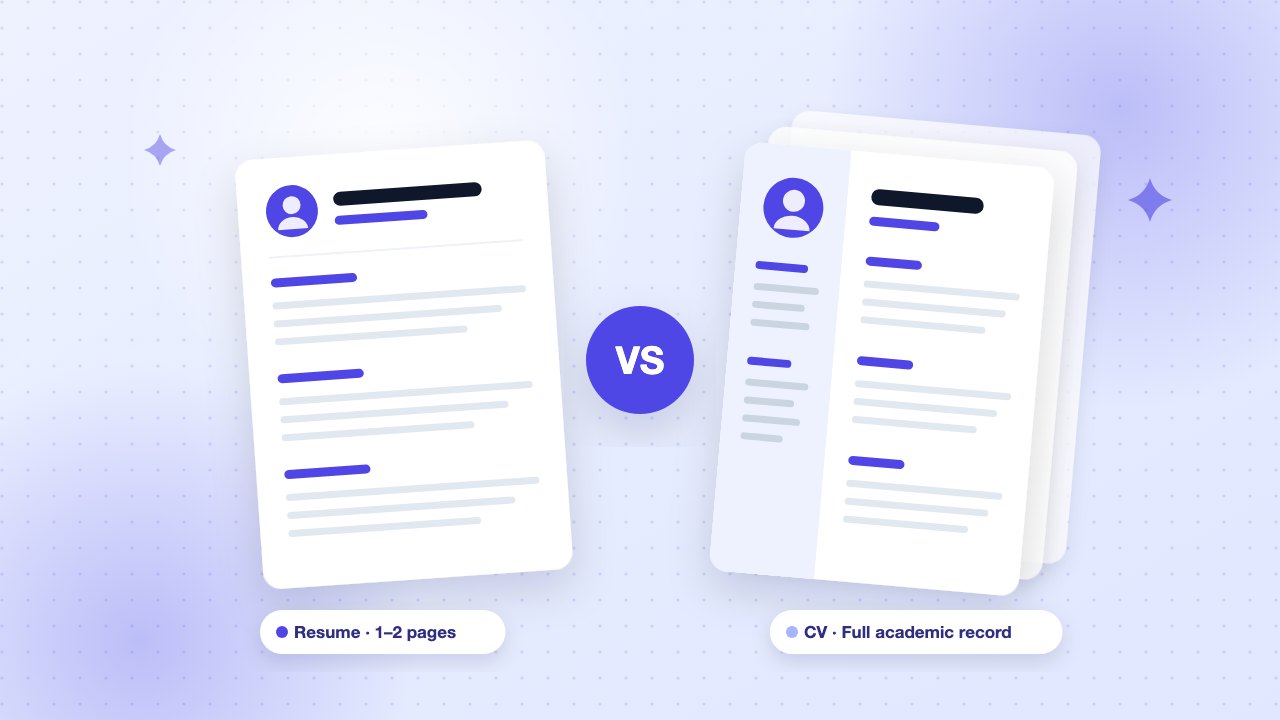
“Please send your CV.” “Attach your resume.” Job postings use both words, sometimes in the same sentence, and it is easy to assume they mean the same thing. They don’t always. Sending the wrong document can make you look unprepared, or bury your best achievements under pages of detail nobody asked for.
The short answer
A resume is a one- to two-page, targeted summary of the experience and skills that matter for a specific job. A CV (curriculum vitae, Latin for “course of life”) is a complete, chronological record of your academic and professional history, and it grows longer over your career.
| Resume | CV | |
|---|---|---|
| Length | 1–2 pages | 2 pages to 10+ pages |
| Purpose | Win an interview for one role | Document your full record |
| Tailored per job? | Yes, every time | Mostly stable; you add to it |
| Typical use | Private sector jobs in the US, Canada, India | Academia, research, medicine, grants; general jobs in the UK, EU, Australia |
| Key sections | Summary, experience, skills, education | Education, research, publications, teaching, grants, conferences |
When to use a resume
Use a resume for most corporate, startup, and private-sector roles, especially in the United States, Canada, and India. Recruiters skim a resume in seconds, so it should show only what proves you can do this job:
- A short professional summary written for the role
- Recent, relevant experience with measurable results
- Skills that match the job description
- Education and certifications, kept brief
When to use a CV
Use a full academic CV when you apply for faculty positions, research posts, fellowships, grants, or medical roles. Reviewers in these fields expect to see everything: every publication, conference talk, teaching assignment, and award.
Geography matters too. In the UK, Ireland, much of Europe, the Middle East, and Australia, people say “CV” for what Americans call a resume. In those markets a “CV” for a corporate job is usually two pages and tailored, so it is really a resume by another name.
Rule of thumb: if the role is academic, scientific, or medical, send a full CV. For almost everything else, send a tailored two-page document, whatever the posting calls it.
What goes in each
Resume sections
- Contact details (name, phone, email, city, LinkedIn or portfolio)
- Professional summary, 2–3 lines
- Work experience with bullet-point achievements
- Skills
- Education and certifications
- Optional: projects, awards, languages, volunteering
Academic CV sections
- Contact details
- Education, including thesis titles and advisors
- Research experience and interests
- Publications and presentations
- Teaching experience
- Grants, fellowships, and awards
- Professional memberships and service
- References
Can one document do both jobs?
Keep a “master” document with everything you have ever done. That is your CV. Every time you apply for a non-academic role, copy it and cut it down to the one or two pages that matter for that job. This saves time and means you never forget an achievement when you need it.
Build either one in minutes
Every ResumeCreating template works as a resume or a CV. Add every section you need, hide the ones you don’t, and download a clean PDF. Need inspiration? Browse our resume examples by industry.